Monday, November 30, 2009

Images of space shuttle Atlantis


1. The Way Home
Seen over the Mediterranean Sea, near the Algerian coast, the space shuttle Atlantis is featured in this image photographed by the Expedition 21 crew on the International Space Station soon after the shuttle and station began their post-undocking separation. Undocking of the two spacecraft occurred at 4:53 a.m. EST on Nov. 25, 2009.


2. Touch Down!
Streams of smoke trail from the main landing gear tires as space shuttle Atlantis touches down on Runway 33 at the Shuttle Landing Facility at NASA's Kennedy Space Center in Florida after 11 days in space, completing the 4.5-million-mile STS-129 mission on orbit 171. On STS-129, the crew delivered 14 tons of cargo to the International Space Station, including two ExPRESS Logistics Carriers containing spare parts to sustain station operations after the shuttles are retired next year.


3.Thin Blue Line
The thin line of Earth's atmosphere and the setting sun are featured in this image photographed by the crew of the International Space Station while space shuttle Atlantis on the STS-129 mission was docked with the station.

Friday, November 27, 2009

Air shed near a highway target either the lungs or heart


Particle pollutants collected from the same air shed (the air within a particular geographic area) near a highway target either the lungs or heart depending on their size and associated chemical components. The research improves understanding of the health impacts of air particles near roads.

More than 50 percent of the total emissions of PM in urban areas are related to road traffic. Near roadway studies have reported associations between traffic density or proximity to roads and respiratory symptoms in children.

Researchers will apply the results to further investigate particulate matter’s (PM) health impact on the heart and lungs.

To learn more about the toxic effects of PM, EPA researchers took samples of three different sizes of the particles – coarse, fine, and ultrafine – near a highway in Raleigh, N.C. Coarse particles (PM2.5-10) are produced by abrasion of automobile brakes and tires and dispersion of road dust, while fine particles (PM0.1-2.5) and ultrafine particles (PM0.1) are emitted from the tail pipe, or form as a result of atmospheric reactions. Researchers then conducted toxicity studies in mice using samples of each particle.

Researchers found the coarse PM produced significant lung effects while ultrafine PM (and to a lesser extent fine PM) induced heart effects. While samples were taken from two locations near the road (22 yards and 301 yards), for the health effects studied, there were no substantial differences in health effects between the two samples although the near road coarse material was enriched for several metal species.

Thursday, November 26, 2009

The Ozone hole over Antarctica - 2009


The size of the annual ozone hole over Antarctica peaked in late September at 23.8 million square miles, slightly smaller than the North American continent, according to a news release from the NOAA in November.

That ranks as the 10th largest since satellite measurements began in 1979. Ozone over South Pole Station also reached its thinnest vertical point of the year on Sept. 26, NOAA reported.The ozone layer in the Earth’s stratosphere, between 10 and 30 kilometers above the ground, helps shield the planet from harmful ultraviolet radiation. Human-produced compounds known as chlorofluorocarbons or CFCs, release ozone-destroying chemicals into the atmosphere responsible for the depletion.

Extreme cold, ice cloud formation in the stratosphere, and a pattern of rapidly circulating air, called the polar vortex, make the ozone layer over Antarctica much more vulnerable to CFC-destruction than anywhere else on the planet.

International agreements have strictly limited the use of CFCs since the early 1990s. Scientists predict the ozone hole will recover by the end of the century.

Scientists in Antarctica, including teams from NOAA and the University of Wyoming, have been measuring atmospheric ozone since 1986.

Monday, November 23, 2009

Final Spacewalk preparations by the Crew

The combined 12-member crew of Atlantis and the International Space Station will move the last of this mission’s spare hardware during the third and final spacewalk today.

Mission Specialists Randy Bresnik and Robert Satcher Jr. are scheduled to begin their six-hour spacewalk an hour late at about 8:18 a.m. EST. They will transfer an oxygen filled High Pressure Gas Tank (HPGT) from the EXPRESS Logistics Carrier 2, or ELC2, located on the starboard truss, to a spot on the outside of the Quest Airlock. The tank will be used to replenish atmosphere lost when spacewalkers enter and exit the station.
While Satcher is relocating the HPGT, Bresnik will install the seventh Materials International Space Station Experiment, or MISSE 7. This is the most advanced of the MISSE payloads to date and will be the first to receive power directly from the station and use the station’s communication system to send commands and downlink real-time data.

On Sunday, Bresnik told the flight controllers his new daughter, Abigail Mae Bresnik, had been born in Houston at 11:04 p.m. CST Saturday. He said his wife Rebecca and new daughter, 6 pounds, 13 ounces and 20 inches long, were doing well. Bresnik got the news by private phone patch through mission control shortly after the crew was awakened.

Thursday, November 19, 2009

NASA's Wide-field Infrared Survey Explorer or Wise is getting ready to roll

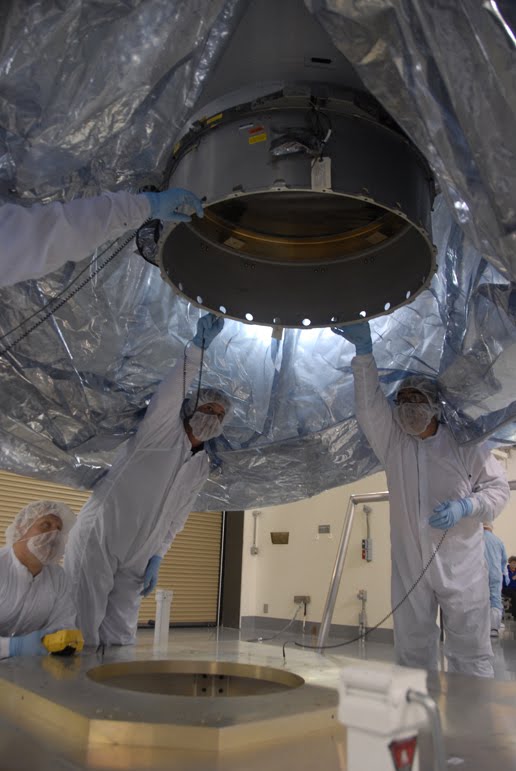
Wise is scheduled to launch no earlier than 6:09 a.m. PST (9:09 a.m. EST) on Dec. 9 from Vandenberg Air Force Base in California. It will circle Earth over the poles, scanning the entire sky one-and-a-half times in nine months. The mission will uncover hidden cosmic objects, including the coolest stars, dark asteroids and the most luminous galaxies.

The mission will map the entire sky at four infrared wavelengths with sensitivity hundreds to hundreds of thousands of times greater than its predecessors, cataloging hundreds of millions of objects. The data will serve as navigation charts for other missions, pointing them to the most interesting targets. NASA's Hubble and Spitzer Space Telescopes, the European Space Agency's Herschel Space Observatory, and NASA's upcoming Sofia and James Webb Space Telescope will follow up on Wise finds.

Wise also will find the coolest of the "failed" stars, or brown dwarfs. Scientists speculate it is possible that a cool star lurks right under our noses, closer to us than our nearest known star, Proxima Centauri, which is four light-years away. If so, Wise will easily pick up its glow. The mission also will spot dusty nests of stars and swirling planet-forming disks, and may find the most luminous galaxy in the universe.

To sense the infrared glow of stars and galaxies, the Wise spacecraft cannot give off any detectable infrared light of its own. This is accomplished by chilling the telescope and detectors to ultra-cold temperatures. The coldest of Wise's detectors will operate at below 8 Kelvin, or minus 445 degrees Fahrenheit.


Monday, November 16, 2009

Mudsnails can mean big trouble: EPA Researchers


Researchers from the U.S. Environmental Protection Agency's Mid-Continent Ecology Division have discovered an invasive species living in the waters of Lake Superior: the tiny New Zealand mudsnail (Potamopyrgus antipodarum).
The snail was discovered in sediments collected from Duluth Superior Harbor and the St. Louis River Estuary during a survey focused specifically on finding new invaders in Great Lakes harbors. EPA researchers found more than 100 New Zealand mudsnails.
Although only about the size of a peppercorn when fully grown, New Zealand mudsnails can mean big trouble. For starters, a snail does not need a partner to reproduce. New Zealand mudsnails breed asexually-essentially cloning themselves. Small populations can quickly explode.
In addition, by closing up its shell, a New Zealand mudsnail can survive for days out of water. Hitching a ride on the bottom of a boat, a pair of hip waders, or some fishing gear, snails can easily be moved accidentally from one body of water to the next. Once the New Zealand mudsnail is established in an area, it's hard to avoid new infestations.
"They have adapted so well in Western rivers that they have pushed out almost all of the native insects, snails, and other invertebrates that are important food for fish," says Doug Jensen, aquatic invasive species program coordinator for Minnesota Sea Grant. "More than 700,000 New Zealand mudsnails per square meter cover the bottoms of some rivers. That's like having 585,000 snails in your bathtub!"
Spreading the Word
State agencies in Minnesota and Wisconsin have launched communications campaigns prior to the beginning of boating and fishing seasons to alert people to look out for the snail, and take actions to reduce the chances of helping the snail spread.

Wednesday, November 11, 2009

Ozone layer and Climate change impact on Air quality


In many areas of the country, ozone pollution on hot summer days is as predictable as an over-abundance of mosquitoes crashing your backyard barbecue. Like sunburn, ground level ozone thrives on sunlight. Keeping the pollutant at regulated levels to protect public health, however, may be an even greater challenge for air quality managers in the near future because of global climate change.

An April 2009 EPA report compiles and assesses the latest science on the implications of climate change for ozone formation in the United States. The report's findings demonstrate the potential for climate change to make ozone management more difficult. The report also highlights the gaps in science that require further study in this relatively new field of modeling climate and atmospheric chemistry.

The studies cannot predict what the future will hold for air quality as climate change continues, but they do provide some of the first critical information that air quality managers and policy makers can use to formulate pollution control strategies.

For example, climate change has the potential to produce significant increases in ground-level ozone in many regions, so air quality managers in areas just below or not in compliance with ozone standards should begin to consider the potential effects of climate change. Climate change also may lengthen the ozone season, so policy makers may need to extend the time over which they monitor ozone concentrations, and issue air quality alerts earlier in the spring and later in the fall.

"This report represents a significant advancement in our understanding of the possible impacts of climate change on air quality in the United States," says Joel Scheraga, National Program Director for EPA's Global Change Research Program. "It is our hope that the work we've done will enhance our ability as a nation to protect air quality and human health, even as the climate changes."

Upcoming reports will focus on other regulated pollutants, such as particulate matter and mercury, and the combined effects of climate and human-caused emissions. This will provide a more complete understanding of the range of possible impacts of global climate change on regional air quality.

Monday, November 02, 2009

Some General tips, while traveling this summer


Plan Ahead...
If you are traveling with perishable food, place it in a cooler with ice or freezer packs. When carrying drinks, consider packing them in a separate cooler so the food cooler is not opened frequently. Have plenty of ice or frozen gel-packs on hand before starting to pack food. If you take perishable foods along (for example, meat, poultry, eggs, and salads) for eating on the road or to cook at your vacation spot, plan to keep everything on ice in your cooler.

Pack Safely...
Pack perishable foods directly from the refrigerator or freezer into the cooler. Meat and poultry may be packed while it is still frozen; in that way it stays colder longer. Also, a full cooler will maintain its cold temperatures longer than one that is partially filled. Be sure to keep raw meat and poultry wrapped separately from cooked foods, or foods meant to be eaten raw such as fruits.

If the cooler is only partially filled, pack the remaining space with more ice. For long trips to the shore or the mountains, take along two coolers — one for the day's immediate food needs, such as lunch, drinks or snacks, and the other for perishable foods to be used later in the vacation. Limit the times the cooler is opened. Open and close the lid quickly.

Now, follow these food safety tips:

When Camping...
Remember to keep the cooler in a shady spot. Keep it covered with a blanket, tarp or poncho, preferably one that is light in color to reflect heat.

Bring along bottled water or other canned or bottled drinks. Always assume that streams and rivers are not safe for drinking. If camping in a remote area, bring along water purification tablets or equipment. These are available at camping supply stores.

Keep hands and all utensils clean when preparing food. Use disposable moist towels to clean hands. When planning meals, think about buying and using shelf-stable food to ensure food safety.

When Boating...
If boating on vacation, or out for the day, make sure the all-important cooler is along.

Don't let perishable food sit out while swimming or fishing. Remember, food sitting out for more than 2 hours is not safe. The time frame is reduced to just 1 hour if the outside temperature is above 90 °F.

Now, about that "catch" of fish — assuming the big one did not get away. For fin fish: scale, gut and clean the fish as soon as they are caught. Wrap both whole and cleaned fish in water-tight plastic and store on ice. Keep 3-4 inches of ice on the bottom of the cooler. Alternate layers of fish and ice. Cook the fish in 1-2 days, or freeze. After cooking, eat within 3-4 days. Make sure the raw fish stays separate from cooked foods.

Crabs, lobsters and other shellfish must be kept alive until cooked. Store in a bushel or laundry basket under wet burlap. Crabs and lobsters are best eaten the day they are caught. Live oysters can keep 7-10 days; mussels and clams, 4-5 days.

Caution: Be aware of the potential dangers of eating raw shellfish. This is especially true for persons with liver disorders or weakened immune systems. However, no one should eat raw shellfish.

When at the Beach
Plan ahead. Take along only the amount of food that can be eaten to avoid having leftovers. If grilling, make sure local ordinances allow it.

Bring the cooler! Partially bury it in the sand, cover with blankets, and shade with a beach umbrella.

Bring along disposable moist towelettes for cleaning hands.

If dining along the boardwalk, make sure the food stands frequented look clean, and that hot foods are served hot and cold foods cold. Don't eat anything that has been sitting out in the hot sun for more than 2 hours (1 hour when the temperature is above 90 °F) — a real invitation for foodborne illness and a spoiled vacation.

When in the Vacation Home or the Recreation Vehicle...
If a vacation home or a recreational vehicle has not been used for a while, check leftover canned food from last year. The Meat and Poultry Hotline recommends that canned foods which may have been exposed to freezing and thawing temperatures over the winter be discarded.

Also, check the refrigerator. If unplugged from last year, thoroughly clean it before using. Make sure the refrigerator, food preparation areas, and utensils in the vacation home or in the recreational vehicle are thoroughly cleaned with hot soapy water.


Wednesday, October 28, 2009

What happens to the polar bears and seals when sea ice melts?


Polar bears and their prey have evolved to living in the extreme conditions of the Arctic. Polar bears and seals are dependent on sea-ice for foraging, resting, and reproduction. The Arctic ecosystem was shaped by climate and continues to be driven today by climate. Polar bears and ice seals, primarily ringed seals, serve as key indicators of the effects of climate change on the Arctic environment. Today, polar bear populations are facing threats previously unprecedented during recorded history in the Arctic. Recent climate change scenarios based upon modeling of climate trend data predict that the Arctic region will experience major changes in the upcoming decades. On the most drastic end of the spectrum one model predicts that the Arctic basin may be void of ice within 50 years. Other models have shown that ice thickness has decreased by 40% during the past 30 years and the average annual extent of ice coverage in the polar region has diminished substantially, with an average annual reduction of over 1 million square kilometers.

While the ultimate or progressively evolving effects of climatic change on polar bear populations is not certain, we do recognize that even minor climate changes could likely have a profound effect on polar bears.

• Climate changes on prey species will have a negative effect on polar bears
o increased snow can result in reduced success in successfully entering seal birth lairs
o decreased snow or increased seasonal rain patterns could effect seal pupping by not providing adequate snow for construction of birth lairs or if rain fall by collapsing birth lairs thus reducing seal productivity
o prey reductions could effect polar bear condition and ultimately cub production and survival

• Changes that alter the period of ice coverage could affect distribution and impact polar bears
o bears may spend greater amounts of time on land
o extended use of terrestrial areas would ultimately effect physical condition of bears when forced to rely on fat stores
o decreased physical condition could effect production and survival
o bears using deteriorating pack ice may experience increased energetic costs associated with movements and swimming

• Denning could be impacted by unusual warm spells
o access to high quality denning areas may be limited or restricted
o use of less desirable denning habitat could have impacts on reproduction and survival
o rain or warming could directly cause snow dens to collapse or be opened to ambient conditions
o loss of thermal insulative properties in opened dens could affect litter survival

Thursday, October 08, 2009

Hummingbird helps researchers to study and monitor air quality


Hummingbirds seem to defy gravity. These tiny fliers can stop in mid-flight, hover, fly backwards, or zip away so fast it appears they simply vanish into thin air, like fairies. To do so, they flap their small but strong, flexible wings at a dizzying rate of 80 beats per second. So fast, that you can hear the characteristic hum of wings cutting through air, but not actually see them move.

The main reason for the hummingbirds' aerial efforts is food. Hummingbirds are nectar specialists, feeding on the sugary, high-energy liquid that plants secrete in their flowers. Hovering gives hummingbirds the ability to efficiently sip nectar where no perches exist. Flying fast between flowers minimizes time between meals, an important factor for an animal that must eat more than one-and-a-half times its weight per day to meet its metabolic demands.

What the researchers find from monitoring hummingbirds will help the EPA's overall efforts to study and monitor air quality. The team plans to build on their initial study this summer by determining the size of the birds' feeding range, which may also be influenced by air quality. Whatever the team discovers in the future may have important implications for human health.

Monday, September 28, 2009

Interesting capabilities of Crocodiles


• they can hold their breath underwater for up to one and a half hours

• they have a lingual gland at the back of the throat that removes salt from their body

• their brain is only the size of a walnut but it still allows enough 'processing' to take place to enable the animal to make a decision about whether to attack or not

• crocs replace their teeth by growing new ones inside old ones which eventually fall out

• the stomach of the crocodile is only about the size of a basketball and contrary to legends and 'old wives' tales', crocs do not store their food - they eat it right away

• of 23 species of crocodiles worldwide, Australian crocodile is considered the most aggressive

Wednesday, September 16, 2009

Facts on Spacesuits and Spacewalking:

1. Spacesuits help astronauts in several ways. Spacewalking astronauts face a wide variety of temperatures. In Earth orbit, conditions can be as cold as minus 250 degrees Fahrenheit. In the sunlight, they can be as hot as 250 degrees. A spacesuit protects astronauts from those extreme temperatures.
2. NASA's first spacesuits were made for the Mercury program. Mercury was the first time NASA astronauts flew into space. The Mercury suits were worn only inside the spacecraft.
3. NASA's first spacewalks took place during the Gemini program.
4. Spacesuits for the Apollo program had boots made to walk on rocky ground. The Apollo suits also had a life support system. The astronauts could go far away from the lunar lander because they weren't connected to it by a hose.
5. Spacesuits like the Apollo suits were used on the Skylab space station missions. Like the Gemini suits, these suits connected to Skylab with a hose.
6. Astronauts wear orange spacesuits called "launch and entry suits" during launch and landing of the space shuttle. In space, these suits can be worn only inside the shuttle.
7. An EVA is a spacewalk that takes place outside of a spacecraft. EVA stands for "extravehicular activity."
8. The first EVA (extravehicular activity, or spacewalk) took place on March 18, 1965, during the Soviet Union's Voskhod 2 orbital mission when cosmonaut Alexei Leonov first departed the spacecraft in Earth orbit to test the concept.
9. Edward H. White II performed the first EVA by an American on June 3, 1965, in Gemini IV.
10. The first EVA that was a moonwalk rather than a spacewalk was made by American astronaut Neil Armstrong on July 20, 1969, during Apollo 11.
11. Twelve men have walked on the moon, two each on six different Apollo missions.
12. Alan Shepard is the only person to hit a golf ball on the moon. During the Apollo 14 mission, he fitted an 8 iron head to the handle of a lunar sample collection device and launched three golf balls. They are still there!
13. The Apollo spacesuit was basically a one-piece suit, which astronauts entered from the back. Each suit was made to fit (custom-tailored to) each astronaut. Apollo 11 astronaut Buzz Aldrin stands on the surface of the moon on July 20, 1969. Apollo 11 Commander Neil Armstrong is seen reflected in Aldrin's helmet visor. Image Credit: NASA
14. Each Apollo mission required 15 suits to support the mission. For the main, or prime, three-man crew, each member had three suits: one for flight; one for training; and one as a flight backup in case something happened to the flight suit. Thus, the prime crew had a total of nine suits. The backup three-man crew each had two suits: one for flight and one for training.
15. Astronauts usually use tethers to keep them attached to the spacecraft while on a spacewalk. The first untethered spacewalk was by American astronaut Bruce McCandless II on Feb. 7, 1984, during Challenger mission STS-41-B.
16. The first woman to perform an EVA was cosmonaut Svetlana Savitskaya during Soyuz T-12 on July 17, 1984.
17. On Oct. 11, 1984, Katherine Sullivan became the first U.S. woman to walk in space.
18. The first and only three-person EVA was performed on May 13, 1992, as the third spacewalk of STS-49.
19. On Feb. 9, 1995, Bernard A. Harris Jr. became the first African-American to perform a spacewalk.
20. The longest EVA was 8 hours and 56 minutes, performed by Susan J. Helms and James S. Voss during STS-102 on March 11, 2001.
21. The first EVA where an astronaut performed an in-flight repair of the space shuttle orbiter was by American astronaut Steve Robinson on Aug. 3, 2005, during STS-114. Robinson removed two protruding gap fillers from space shuttle Discovery's heatshield while the shuttle was docked to the International Space Station.
22. Cosmonaut Anatoly Solovyev holds the record for the most spacewalks -- 16, with a total duration of 82 hours and 22 minutes.
23. Captain Michael Lopez-Alegria holds the American record for number of EVAs -- 10, with a total duration of 67 hours and 40 minutes.Space shuttle astronaut Bruce McCandless became the first astronaut to maneuver about in space untethered. He wore a jetpack-like device called the Manned Maneuvering Unit, or MMU. Image Credit: NASA
24. A spacesuit weighs approximately 280 pounds on the ground -- without the astronaut in it. In the microgravity environment of space, a spacesuit weighs nothing.
25. Putting on a spacesuit takes 45 minutes, including the time it takes to put on the special undergarments that help keep astronauts cool. After putting on the spacesuit, to adapt to the lower pressure maintained in the suit, the astronaut must spend a little more than an hour breathing pure oxygen before going outside the pressurized module.
26. The reason that spacesuits are white is because white reflects heat in space the same as it does here on Earth. Temperatures in direct sunlight in space can be more than 275 degrees Fahrenheit.
27. No difference exists in a male's or female's suit, though the female astronaut usually requires a smaller size.
28. The shuttle spacesuit was designed to be made of many interchangeable parts, to accommodate the large number of astronauts with widely varying body sizes. These parts (upper and lower torsos, arms, etc.) are made in different sizes.
29. The body measurements of each shuttle astronaut are taken and recorded. Then the measurements are plotted against the size ranges available for each spacesuit component. The suit components are then assembled. Training suits are usually assembled nine months prior to flight, and flight suits are usually assembled four months prior to flight.
30. Shuttle spacesuits are made by sewing and cementing various materials together, and then attaching metal parts that let the different components be joined together.
31. Shuttle spacesuit materials include ortho-fabric, aluminized mylar, neoprene-coated nylon, dacron, urethane-coated nylon, tricot, nylon/spandex, stainless steel, and high-strength composite materials.
32. Just before a shuttle mission, the suits designated for flight are tested, cleaned and packed at NASA's Johnson Space Center in Houston. Then they are flown to NASA's Kennedy Space Center in Florida and stowed on the shuttle orbiter. After each flight, the suits are returned to Johnson for postflight processing and reuse.
33. The Neutral Buoyancy Lab is a large indoor pool that is 202 feet in length, 102 feet in width, and 40 feet in depth (20 feet above ground level and 20 feet below). The pool holds 6.2 million gallons of water.
34. The Sonny Carter Training Facility including the Neutral Buoyancy Lab provides controlled neutral buoyancy operations to simulate the microgravity or weightless condition that is experienced by spacecraft and crew during spaceflight. For the astronaut, the facility provides important preflight training for extravehicular activities and with the dynamics of body motion under weightless conditions.Astronauts practice repairs to a Hubble Space Telescope model underwater at the Neutral Buoyancy Lab in Houston, Texas. Image Credit: NASA
35. Some astronauts train for spacewalks on the Precision Air Bearing Floor. The PABF is like a giant air hockey floor where jets of air allow massive objects to move with no friction. The floor is a metal surface 32 feet by 24 feet (10 meters by 7 meters). Moving something along on the floor gives an astronaut a sense of how an object might move in space with no force of gravity acting on it.
36. POGO is a device that uses cables connected to the ceiling to suspend an astronaut. POGO supports five-sixths of a person's weight; it mimics the one-sixth gravity of the moon. An astronaut walking around on POGO has the sensation of walking on the moon. POGO has been around since the Apollo days -- in fact, the device gets its name from the way Apollo astronauts tended to bounce when suspended from it. The real name for POGO is the Partial Gravity Simulator.
37. Astronauts use Lower Torso Assembly Donning Handles to pull the spacesuit pants up onto their bodies.
38. The spacesuit has two other sets of gloves that astronauts can use. Comfort Gloves are worn under the EVA glove and aid EVA glove donning, doffing and wicking away perspiration. They provide some additional thermal protection. Adjustable Thermal Mittens provide added protection in extreme temperature environments.
39. Thermofoil heaters are attached inside each of the fingertips in one of the layers of the glove. The heaters are located approximately over each of the crew member’s fingernails. The heaters have an on-off switch near each of the gloves' wrists.
40. EVA astronauts usually handle from 70 to 110 tools, tethers and associated equipment for a typical spacewalk.
41. Putting a spacesuit on is called "donning" the suit. Removing the suit is called "doffing."

Tuesday, September 08, 2009

Common characteristics of tiger

Tigers have historically lived in a wide variety of climates and habitats from Turkey east to China and from Siberia south to the Indonesian islands. They are the largest of the cats living on earth today.

After about 103 days of gestation, female tigers of all the subspecies produce a litter of between 1 and 5 cubs (2-3 is average). At 8 weeks, cubs start learning to hunt with their mother. By 6 months they have learned the basics of killing animal. It will be about 1 ½ years before they can really hunt and sustain themselves on their own.

Because these cats are so large, they require large species of prey animals. As you imagine, tigers naturally travel over large areas in search of prey. As the human population of the world and fragmentation of forests and wild lands continues, tigers are colliding with humans and losing the battle for wild places with enough large prey animals to sustain them. Tigers are also being killed for their spectacular fur coats and for Asian medicinal products.

Monday, August 31, 2009

Tips to help your kids to stay at correct weight

One of the best ways to prevent overweight and obesity in your child is to improve the eating and activity levels of your entire family.

Parents are often their children’s most important role model. If you eat right and are physically active, there is a good chance your children will make these choices, too. Plus, getting active and eating healthy as a family will help you spend more quality time together.

Put 1 hour of physical activity into your child's day.
It doesn't have to be 60 minutes all at once – it can be different activities that add up to 1 hour. Fun activities that children do on their own are often the best. Playing tag or hide–and–seek can be great for burning calories.
Be sure your child is doing different types of activity, including:
  • Aerobic activities like running, skipping, or dancing
  • Muscle–strengthening activities like climbing trees or playground equipment
  • Bone–strengthening activities like jumping rope or playing basketball

Friday, August 28, 2009

ISRO’s next mission is to mars

After the challenging mission to moon, ISRO on Wednesday said it has begun preparations for sending a spacecraft to Mars within the next six years.

The Government has sanctioned seed money of Rs 10 crore to carry out various studies on experiments to be conducted, route of the mission and other related details necessary to scale the new frontier, said ISRO Chairman G Madhavan Nair.
Justify Full
"Already mission studies have been completed. Now we are trying to collect scientific proposals and scientific objectives," he told reporters on the sidelines of a day-long workshop of the Astronautical Society of India in New Delhi.

He said the space agency was looking at launch opportunities between 2013 and 2015.
Chandrayaan-I, the country's maiden unmanned moon mission, appears to have fired the imagination of young scientists who have taken to space sciences and ISRO plans to tap this talent for its mission to Mars.

"A lot of young scientists are being brought into the mission, particularly from the Indian Institute of Space Technology, the Physical Research Laboratory, Tata Institute of Fundamental Research and other research laboratories," K Radhakrishnan, Director of Vikram Sarabhai Space Centre, said.

He said the space agency would use its Geosynchronous Satellite Launch Vehicle (GSLV) to put the satellite in orbit and was considering using ion-thrusters, liquid engines or nuclear power to propel it further towards Mars. (ST-12/08)

Tuesday, August 25, 2009

Vaccines are necessary to fight against deadly diseases

Disease prevention is the key to public health. It is always better to prevent a disease than to treat it. Vaccines prevent disease in the people who receive them and protect those who come into contact with unvaccinated individuals. Vaccines help prevent infectious diseases and save lives. Vaccines are responsible for the control of many infectious diseases that were once common in this country, including polio, measles, diphtheria, pertussis (whooping cough), rubella (German measles), mumps, tetanus, and Haemophilus influenzae type b (Hib).

Vaccine-preventable diseases have a costly impact, resulting in doctor's visits, hospitalizations, and premature deaths. Sick children can also cause parents to lose time from work.

Each child is born with a full immune system composed of cells, glands, organs, and fluids that are located throughout his or her body to fight invading bacteria and viruses. The immune system recognizes germs that enter the body as "foreign" invaders, or antigens, and produces protein substances called antibodies to fight them. A normal, healthy immune system has the ability to produce millions of these antibodies to defend against thousands of attacks every day, doing it so naturally that people are not even aware they are being attacked and defended so often (Whitney, 1990). Many antibodies disappear once they have destroyed the invading antigens, but the cells involved in antibody production remain and become "memory cells." Memory cells remember the original antigen and then defend against it when the antigen attempts to re-infect a person, even after many decades. This protection is called immunity.

Vaccines contain the same antigens or parts of antigens that cause diseases, but the antigens in vaccines are either killed or greatly weakened. When they are injected into fatty tissue or muscle, vaccine antigens are not strong enough to produce the symptoms and signs of the disease but are strong enough for the immune system to produce antibodies against them (Tortora and Anagnostakos, 1981). The memory cells that remain prevent re-infection when they encounter that disease in the future. Thus, through vaccination, children develop immunity without suffering from the actual diseases that vaccines prevent.

Friday, August 21, 2009

Planetesimals

For those of you scoring at home," planetesimals" were the first solid objects in our newly minted solar system (also known as the protoplanetary disk). They began life as small grains of dust orbiting an infant sun. These grains would bump into each other, clump together and gradually form larger grains of dust, which eventually became small space rocks.

Now the theory goes that some of these small rock-sized planetesimals aspired for greater things, and continued to gradually grow in size to become asteroids, and that a few of those continued to grow beyond the asteroid stage and become planets.

The problem with this tidy little theory is that when the burgeoning space rocks grew to about one meter (3.3 feet) in size, orbital mechanics tells us the gas comingling with them in the protoplanetary disk should have acted like a brake, slowing their velocity appreciably. Their orbital speed having been cut, these filing cabinet-sized space rocks would have spiraled into the sun. Essentially, the gas would have acted as a celestial "mini-vacuum." The problem is, there are asteroids up there in space. Honest, ask any astronomer. So what happened?

Evidence is now mounting that these small space rocks quickly "jumped" (or grew) in size from below one meter to multi-kilometer in size. Planetesimals that big were big enough to plow through the drag created by the gas in the protoplanetary disk without having their orbits appreciably altered. Hence they did not spiral into the sun.

What data point to a jump in asteroid sizes? Simply, the asteroids available for viewing in the night's sky. Telescopic surveys indicate there is currently a plethora of asteroids less than one kilometer (.62 mile) wide but those over one kilometer drop considerably in number. The authors used computer simulations in an attempt to mimic the impacts and coagulation processes that took place over the millions of years between when the asteroids formed and now. The only way they could arrive at the current asteroid size distribution was to begin these simulations with planetesimals that quickly morphed into asteroids hundreds of kilometers in size. Once their growth spurt was over, these massive celestial bodies began an epoch-sized game of demolition derby as they orbited the sun. Over the eons, and with each extraterrestrial pileup, came fewer and fewer large asteroids - a fragmentation process that continues to this day. Despite the modest sizes of asteroids today, the paper's authors conclude that asteroids must have been born big.

Sunday, August 16, 2009

Lightning

Lightning is the MOST UNDERRATED weather hazard. On average, only floods kill more people. Lightning makes every single thunderstorm a potential killer, whether the storm produces one single bolt or ten thousand bolts.

In the United States, lightning routinely kills more people each year than tornadoes or hurricanes. Tornadoes hail, and wind gusts get the most attention, but only lightning can strike outside the storm itself. Lightning is the first thunderstorm hazard to arrive and the last to leave.

Lightning is one of the most capricious and unpredictable characteristics of a thunderstorm. Because of this, no one can guarantee an individual or group absolute protection from lightning. However, knowing and following proven lightning safety guidelines can greatly reduce the risk of injury or death. Remember, YOU are ultimately responsible for your personal safety, and should take appropriate action when threatened by lightning.While no place is 100% safe from lightning, some places are much safer than others.

Where to Go
The safest location during a thunderstorm is inside a large enclosed structure with plumbing and electrical wiring. These include shopping centers, schools, office buildings, and private residences.
If lightning strikes the building, the plumbing and wiring will conduct the electricity more efficiently than a human body. If no buildings are available, then an enclosed metal vehicle such as an automobile, van, or school bus makes a decent alternative.

Where NOT to Go
Not all types of buildings or vehicles are safe during thunderstorms. Buildings which are NOT SAFE (even if they are "grounded") have exposed openings. These include beach shacks, metal sheds, picnic shelters/pavilions, carports, and baseball dugouts. Porches are dangerous as well.
Convertible vehicles offer no safety from lightning, even if the top is "up". Other vehicles which are NOT SAFE during lightning storms are those which have open cabs, such as golf carts, tractors, and construction equipment.

Tuesday, August 11, 2009

Gas Mileage Tips

Aggressive driving wastes gas. It can lower your gas mileage by 33 percent at highway speeds and by 5 percent around town. Sensible driving is also safer for you and others, so you may save more than gas money.

Observe the speed limit, While each vehicle reaches its optimal fuel economy at a different speed, gas mileage usually decreases rapidly at speeds above 60 mph.

Remove Excess Weight, excess weight in your vehicle could reduce your MPG.

Avoid Excessive Idling, idling gets 0 miles per gallon. Cars with larger engines typically waste more gas at idle than do cars with smaller engines.

Keep Your Cars in Shape-Keep Your Engine Properly Tuned, Keep Tires Properly Inflated and Use the Recommended Grade of Motor Oil.

Friday, August 07, 2009

White Water Rafting and Trekking in Darjeeling

White Water Rafting in Darjeeling

"White Water Rafting" is an adventure Hill Sport, which is relatively new in the Darjeeling Hills. Beckon the strong hearted as Darjeeling is also home to the mighty River Teesta and Rangeet whose turbulent currents make a formidable challenge to even the seasoned rafter. There is however a wide range in the intensity of the rapids making it adequate for all, the young and the aged to enjoy the spectacular scenery while leisurely snaking down the river. The Dept. of Tourism, DGHC has successfully promoted this sport and has acquired well trained members and quality equipment ensuring a safe and pleasant ride to all visitors.
Tourist should spare a day during their stay in Darjeeling and take a one and half hour drive down to Teesta Bazar to enjoy this Hill Sport. "Assumption of Risk and Release" bond has to sign before undertaking the trip.

Trekking in Darjeeling

Darjeeling internationally acclaimed as one of the best hill resorts is also a veritable paradise for trekkers and adventure seekers. Trekking in Darjeeling is an experience which no lover of nature should miss. It takes one to places where nature is yet in her premival majesty. It brings one face to face with the sublime grandeur of the Himalayas.
The region abounds in rhododendrons,magnolias,primulas,orchids and ferns of numerous varities. About six hundred different species of birds inhabit the emerald green forests on the slopes of the mountains. The following is a brief description of some of the most popular and most rewarding treks in the region.